CPAN 2025 Year in Review
CPAN Patient Advocacy in 2025: Education, Stories, and Policy in Action
Cancer care is about more than treatment. It is also about who delivers that care, where it happens, and whether patients can access it. In 2025, the COA Patient Advocacy Network (CPAN) spent the year teaching patients and caregivers about these issues, while lifting up their stories and connecting them with real policy work at the state and federal levels.
This recap walks through how CPAN operates, what happened in 2025, and how advocates like you can plug in, from local clinics to Capitol Hill.
What Is CPAN? The Patient Voice of COA
CPAN is the national patient advocacy arm of the Community Oncology Alliance (COA), which has been active for more than 20 years. COA is well known in Washington, D.C. and across many cancer centers, and CPAN brings the patient and caregiver voices into that work.
CPAN focuses on foundational learning and advocacy education so that when patients meet with policymakers, they feel prepared and confident.
Foundational Learning: Starting With the Basics
Many patients treated in a private or networked practice do not know that the place where they receive treatment is called a community oncology practice. They are not thinking about whether it is academic, nonprofit, or a joint venture. They care about their relationship with their care team and whether they can get the care they need.
CPAN leaders see this pattern over and over again. So, they begin by explaining:
- What community oncology is
- Why site of care matters
- What threatens access to local cancer clinics
Only after these basics feel clear does CPAN move into deeper topics.
From Basics to Policy Topics
Once patients and caregivers understand where they are being treated, CPAN introduces:
- Who COA is and how it advocates
- How payment and policy affect local cancer clinics
- What happens when clinics are forced to close or are bought out
Key policy topics include:
- Pharmacy benefit managers (PBMs)
- Prior authorization delays
- Cancer practice consolidation
The goal is to give patients enough context to see how their own experience fits into a bigger picture, not to turn them into policy experts.
Why Patient Stories Matter in Cancer Policy
Education is just the first step. CPAN also helps patients connect their stories to policy in a clear, focused way.
Patients often say:
- “I love my doctor!”
- “I love my nurses!”
- “I love this cancer center!”
When they understand that certain policies could threaten that care, they want to act. CPAN shows them how.
As CPAN Director, Rose Gerber, MS, often explains, what makes change is when patients share their stories with state and federal policymakers. A short, honest story that ties a real problem to a clear policy ask is powerful.
How CPAN Supports COA and the Cancer Care Team
CPAN does a lot of work that advocates might not see.
It supports COA’s internal networks, such as:
- The Community Oncology Pharmacy Association (COPA)
- The COA Administrators’ Network (CAN)
- State policy teams
Patients and survivors who join CPAN often enjoy being part of these efforts. Their input adds a real patient voice to meetings and projects that might otherwise feel purely technical.
CPAN also works with COA’s industry partners. These companies develop the drugs that keep many cancer survivors alive or extend patients’ lives. When there are patient-focused programs or resources, CPAN helps share them with nurses, pharmacists, and practice leaders.
When it makes sense, CPAN collaborates with other national advocacy organizations, too, sharing tools and information that help patients and caregivers.
The People Behind CPAN: Patients, Survivors, Caregivers, and Staff
At COA’s Conference in April, cancer survivors and advocates from across the country gathered for the Advocacy track. Some were people who have gone through chemotherapy, surgery, radiation, or targeted therapies, while some were still in treatment. They showed up anyway, smiling for photos, telling their stories, and learning how to advocate.
CPAN is not only for patients. Members include:
- Survivors
- Caregivers
- Nurses and nurse navigators
- Pharmacists
- Medical assistants
- Practice managers
- Oncologists and administrators who support advocacy
In CPAN’s view, everyone in a community oncology practice can be an advocate.
CPAN Chapters Across the Country
To reach people where they receive care, CPAN builds local chapters.
So far, CPAN has:
- 37 chapters across 23 states
Some chapters are very active. Others have slowed down because their practices were sold, consolidated, or closed, often due to the very policies COA warns about and fights against.
Still, even a chapter that no longer meets has left a mark. When that chapter launched, patients, survivors, nurses, and pharmacists learned about COA, CPAN, and current policy issues. That knowledge does not disappear.
From Education to Action on Capitol Hill
Many advocates are excited about going to Capitol Hill or their state capitol. Before they do, CPAN makes sure they are ready.
COA’s policy priorities include topics such as:
- Sustainable provider payment
- Prior authorization reform
- PBM abuses
- Anti-competitive hospital pricing
This language can feel foreign to patients. CPAN teaches these issues in patient-friendly terms, without changing the underlying message.
Advocates learn what COA is working on, then practice talking about how those issues show up in their own lives. Only then do they travel to meet with lawmakers.
Storytelling as Advocacy Training
At the COA Conference, the Advocacy track includes a detailed storytelling session.
Patients are not asked to give a 45-minute talk on every part of their cancer journey. Instead, they learn to:
- Share a short, clear part of their story
- Tie it directly to one policy issue
- End with a specific ask
One example came from a patient named Tonsa, whose story is shared on YouTube and in CPAN training. She learned about community oncology, spoke on Capitol Hill, and now her story helps teach other advocates.
It becomes a cycle. Patients learn, advocate, and then inspire the next group.
Advocacy Chats: Year-Round Virtual Education
To keep education going all year, CPAN hosts virtual Advocacy Chats. These are free webinars that began in 2020.
Their goals are to:
- Explain COA’s policy and advocacy work
- Highlight the value of the oncology workforce
- Give patients and caregivers practical information
In 2025 alone, Advocacy Chats received over 1,000 views. Since their launch, they have recorded more than 15,000 views, with 59 chats and 54 speakers.
Topics this year included:
- COA policy initiatives and resources
- The role of nurses, pharmacists, and other staff in community oncology
- Nutrition and survivorship
- Caregiving and the survivor experience
- A year-in-review session on CPAN’s work
Who Takes the Virtual Stage?
Speakers have included:
- Senior COA leadership
- Leaders from long-established national organizations, such as the Prevent Cancer Foundation
- Representatives from member practices, including Florida Cancer Specialists and Research Institute
- Oncology nurses and pharmacists
- Survivorship leaders, such as Shelley Fuld Nasso from NCCS
- COA staff who focus on health equity, pharmacy, and policy
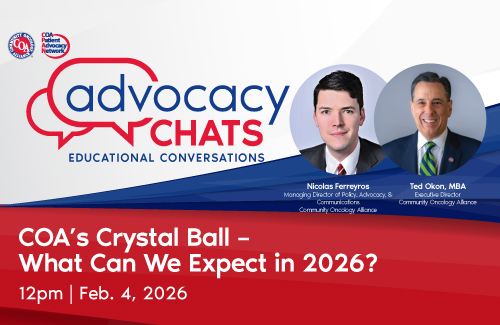
The first Advocacy Chat of each new year traditionally features COA’s executive director, Ted Okon, along with other senior leaders.
Working With Industry and National Partners
CPAN also connects with outside organizations when their work aligns with community oncology.
Examples include:
- Attending the CancerCare gala in New York on behalf of COA
- Featuring the CEO of CanCare on an Advocacy Chat
- Sharing resources from groups focused on specific cancers
- Highlighting genetic counseling resources for nurses and pharmacists
On the industry side, CPAN attends advocacy-focused events hosted by pharmaceutical partners. One example is Pfizer’s annual advocacy gathering at ASCO in Chicago, where leaders from across the country meet to share ideas and recharge.
CPAN’s director, Rose Gerber, MS, is herself a cancer survivor. She has served as a patient representative in COA’s work with ASCO on the Oncology Medical Home model and is honored to be an author on a major publication from that project.
Building Opportunities for Advocates
CPAN works to turn education into real opportunities.
Advocates have the opportunity to:
- Speak at the COA Conference
- Join panel discussions and trainings
- Be featured in video campaigns
- Receive scholarships to attend events
- Travel to Washington, D.C. for Hill Days
In 2025, COA’s Director of Communications also launched more formal training for selected advocates. Five CPAN advocates from practices in Nevada, New York, Georgia, and Virginia were trained as “advocates on call” so they are ready to speak on short notice when media or policymakers need a patient voice.
Chapter Leaders and Everyday Advocacy
CPAN chapters support advocacy in many ways, not just by traveling to D.C.
- Lisa Poiry, RN, OCN, from Fort Wayne Medical Oncology and Hematology joined COA’s state policy division on stage at the COA Conference
- Cyndi Przekop, RN, BSN, another chapter leader, spoke at COA’s fall State Leadership Retreat
- Angelina Lorello spoke to college students at the University of Rhode Island about community oncology and CPAN
Sit in My Chair: Bringing Policymakers into the Clinic
COA continues to support “Sit in My Chair” events, where lawmakers visit community oncology clinics and see treatment chairs, infusion rooms, and staff in action.
In 2025, practices such as Florida Cancer Specialists and AON hosted their representative for these visits, with strong support from their marketing and advocacy teams.
Clearview Cancer Institute: CPAN’s Newest Chapter in Alabama
One of the biggest highlights of 2025 was the launch of a new CPAN chapter at Clearview Cancer Institute in Huntsville, Alabama.
This chapter is led by:
- Chelsey Karr, CRNP, Director of Education
- Rebekah Ormond, Volunteer Coordinator
The idea grew naturally. Rebekah was invited to speak on a panel at the April COA Conference, her first time attending. While there, she learned that the Advocacy track had returned after the pandemic pause.
Clearview’s COO, Michelle Brown, challenged her to start a patient advocacy effort at the practice and to represent Alabama in CPAN. Rebekah approached Rose at the Conference and asked how they could partner. CPAN welcomed Clearview quickly, providing tools and guidance.
At the October 28 launch:
- Michelle Brown opened the evening and welcomed everyone
- Dr. Sri Bathini spoke about her advocacy for her patients and the barriers she sees in community oncology
- Patients, caregivers, and staff attended, including medical assistants, nurse navigators, prior authorization staff, pharmacists, and site coordinators
Chapter leaders made sure the night felt warm and practical while focusing on a shared purpose.
First Meetings and Early Wins
Clearview held its first chapter meeting shortly after the launch event.
They chose a roundtable format to encourage open conversation. Participants revisited what CPAN and COA do, then spent time on PBMs and how they affect access, cost, and even clinic stability.
Their retail pharmacy manager joined and fielded a flood of questions. One attendee was not a patient or caregiver but worked in home care and simply felt called to get involved.
As people learned about PBMs and other policies, their next question was, “How do we do something about this?” Clearview’s leaders pointed them toward CPAN Advocacy Chats, future COA events, and upcoming advocacy opportunities.
Conclusion: Your Voice Is the Difference
CPAN’s 2025 story is simple. When patients, survivors, caregivers, and staff understand community oncology and speak up, policy conversations change.
If you care about keeping cancer care locally and strong, there is a place for you in this work. You can join Advocacy Chats, ask about starting a CPAN chapter at your clinic, share your story, sign up for COA and CPAN newsletters, and/or follow on social media.
Thank you for the time you give to cancer advocacy. The more informed voices at the table, the better the future will be for every patient who walks into a community oncology practice.
CPAN Advocacy Chats are regular virtual 30-minute educational conversations about cancer advocacy and policy with a guest speaker invited to discuss issues important to patients and advocates. Summaries of previous Advocacy Chats are available on the CPAN website.
Past Advocacy Chats